Tonight a conversation with Rachel Hadas, the poet, professor, essayist and translator about her newest book: Poems for Camilla. February 28, 2019
“At a moment when ignorance, stupidity, and a dogged refusal to learn from the past are rampant, how salutary to read a very contemporary poet in dialogue with Virgil about such timeless and pertinent issues as war, continuity, guilt, grief, and consolation.”
-Marlilyn Hacker writing about Poems for Camilla
I first met Rachel about nine years ago during the days just after The Greek Poets was  published. It was at a reading held to launch the book. I forget the venue—a mid-town art gallery—but I didn’t forget her. I knew I wanted her to be a guest on Graffiti but the timing just wasn’t right. Again the timing was bad when we met a few years later at a reading at The Cornelia Street Cafe. Lamentably The Cornelia Street Cafe is now gone.
Recently I was at a reading at Hudson Valley Writers Center where Rachel was one of the featured artists. After the program I  approached her and…well the result is she’s here tonight.
Rachel Hadas studied classics at Harvard, poetry at Johns Hopkins, and comparative literature at Princeton. Between college and graduate school she spent four years in Greece, an experience that surfaces variously in much of her work. Since 1981 she has taught in the English Department of the Newark (NJ) campus of Rutgers University, and has also taught courses in literature and writing at Columbia and Princeton, as well as serving on the poetry faculty of the Sewanee Writers’ Conference and the West Chester Poetry Conference. She has received a Guggenheim Fellowship in Poetry, an Ingram Merrill Foundation grant in poetry, and an award in literature from the American Academy and Institute of Arts
and Letters.
Rachel Hadas is the author of many books of poetry, prose, and translations. A memoir about her husband’s illness, “Strange Relation,” was published by Paul Dry Books in 2011. Her previous book of poems, “The Golden Road,” was published by Northwestern University Press in the fall of 2012.
from Rachel’s website (see link below)
So remember: Tune in tonight at 7pm to listen to my conversation with Rachel. The program is available at our website CosmosFM.org or on the radio at WNYE, 91.5 or use the TUNEIN app on your smart device.
 CLICK HERE FOR the link to Rachel’s website.
CLICK HERE FOR the link to Rachel’s wikipedia page.
CLICK HERE FOR the POETRY FOUNDATION page dedicated to Rachel Hadas.
CLICK HERE FOR the video “Equipoise” featuring Rachel.
CLICK HERE FOR the video “Cento” featuring Rachel.
CLICK HERE FOR Back Roads Readings 2019.

Back at the end of October 2017 I had Panio Gianopoulos on the show to talk about his new book of stories entitled: How to Get into Our House and Where We Keep the Money. On Friday night March 8 he will be at Hudson Valley Writers Center along with Daneille Trussoni. It will be an exciting evening of readings.
CLICK HERE FOR more information about the event.
CLICK HERE FOR for the link to the blog entry for the show in October 2017.
A Conversation with Kiki Karoglou, Curator of Dangerous Beauty: Medusa in Classical Art at the Met Fifth Avenue until February 24, 2019
Kiki Karoglou joined the department in 2011. She previously taught at the University of Toronto and The College of New Jersey, and held graduate internships at the Getty Research Institute, the Princeton Art Museum, and the Athens Acropolis Museum. Kiki received her PhD in classical art and archaeology from Princeton University and has participated in numerous archaeological excavations in the Mediterranean. Kiki contributed to the exhibition Pergamon: Hellenistic Kingdoms of the Ancient World (April 11–July 17, 2016) and organized the department’s current exhibition Dangerous Beauty: Medusa in Classical Art (February 5, 2018–February 24, 2019).
Selected Publications:
Karoglou, Kiki. Attic Pinakes: Votive Images in Clay. Oxford: Archaeopress, 2010.
———. “Eros Mousikos.” In Representations of Musicians in the Coroplastic Art of the Ancient World: Iconography, Ritual Contexts, and Functions, edited by A. Bellia and C. Marconi, 97–107. TELESTES. Studi e Ricerche di Archeologia musicale nel Mediterraneo II. Pisa-Roma: Istituti Editoriali e Poligrafici Internazionali, 2016.
“Dangerous Beauty: Medusa in Classical Art.” The Metropolitan Museum of Art Bulletin, 75.3 (Winter, 2018).

from MEET THE STAFF at the Metropolitan Museum of Art website

Exhibition Overview Beginning in the fifth century B.C., Medusa—the snaky-haired Gorgon whose gaze
turned men to stone—became increasingly anthropomorphic and feminine, undergoing a visual transformation from grotesque to beautiful. A similar shift in representations of other mythical female half-human beings—such as sphinxes, sirens, and the sea monster Scylla—took place at the same time. Featuring sixty artworks, primarily from The Met collection, this exhibition explores how the beautification of these terrifying figures manifested the idealizing humanism of Classical Greek art, and traces their enduring appeal in both Roman and later Western art.
The connection between beauty and horror, embodied above all in the figure of
Medusa, outlived antiquity, fascinating and inspiring artists through the centuries. Medusa became the archetypical femme fatale, a conflation of femininity, erotic desire, violence, and death. Along with the beautiful Scylla, she foreshadows the conceit of the seductive but threatening female that emerges in the late nineteenth century in reaction to women’s empowerment.
from CURRENT EXHIBITIONS at the Metropolitan Museum of Art website
So remember: Tune in tonight at 7pm at our website CosmosFM.org or on the radio at WNYE, 91.5 or use the TUNEIN app on your smart device.
CLICK HERE for more about Dangerous Beauty.

A Conversation with Gary Lachman, author of Lost Knowledge of the Imagination, PART 2…January 31, 2019

Pretty much everything you need to know is in my previous blog entry dated January 17, 2019.
But there are a few things you should know about this show.
First, we will be recapping with two clips from PART 1 some of the things you’ll want to know if you missed that program.
Second, you can hear that first program in its entirety if you go to our SoundCloud page. CLICK HERE.
 And finally, at the bottom of the previous blog entry I put a link to the class I’ll be teaching at Hudson Valley Writers Center on how to become a better public speaker. Since that entry there have been a few changes made. First, it is no longer six sessions but four. The price has dropped significantly and we will start on February 19th and not the 5th.
CLICK HERE if you want to be taken to the previous blog dated January 17, 2019.
A Conversation with Gary Lachman, author of Lost Knowledge of the Imagination, PART 1…January 17, 2019
I think the two paragraphs that open Gary Lachman’s wikipedia entry pretty much hits the high points of his life:
Gary Joseph Lachman (born December 24, 1955, Bayonne, New Jersey, United States), also known as Gary Valentine, is an American writer and musician.
He came to prominence in the mid-1970s as the bass guitarist for the punk rock/new wave band Blondie. Since the 1990s, Lachman has written full-time, often about mysticism and occultism.
From being Blondie’s bass player to what the Washington Post writes about him:  “Lachman writes about philosophical and mystical ideas with exceptional grace, forcefulness and clarity.” But what about how he got from Punk to mysticism? Listen tonight and you hear him tell his story in his words.
Interesting man. Interesting book.
So remember: Tune in tonight at 7pm at our website CosmosFM.org or on the radio at WNYE, 91.5 or use the TUNEIN app on your smart device.
There are a number of links below for you to explore more about Gary Lachman and his  books but other then that there’s not much I can add other then to say Part 2 of our conversation can be heard on Thursday, January 31.
CLICK HERE for Gary Lachman’s website.
CLICK HERE for Gary Lachman’s wikipedia page.
CLICK HERE for a video of Gary Lachman talking about Imagination and Knowledge.
CLICK HERE Gary’s webpage for Lost Knowledge of the Imagination.
 For as long as I can remember I’ve done a year-end wrap-up show…and tonight’s the night.
2018 was not marked by quantity—I only did about a dozen shows and it seems that many of them were fundraisers—but, if I must say so myself the QUALITY was quite good.
How do I know? That’s simple. To prepare for this show I had to listen to every single one of them so I could decide which clips I wanted to edit from the  shows.
Some were easy. I remembered a few moments from some of the shows that really stood out and stuck in my mind. In nearly every case my memory served me well, but there were times when I got to the appropriate place in the audio I found that my idea or my memory was faulty.
 But it was fun to go back and listen. In fact there were a few shows where I found myself thinking, “Oh, this section has to be the clip!” Only to continue on and find an even better segment to use.
 After I pulled the clips I thought about them and knew there
  was a theme or thread that connected them. As a result I’ve come up with three interlocking themes: 1) The Artist and his/her path. 2) Friendship and digging deeper. 3) The Zeitgeist of the times.
Here are the names of the guests and the date we originally had our conversations: Steven Pressfield, August 30; Lili Maya & James Rouvelle, October 25; Michele Poulous, April 12; Jennifer Franklin, December 6;  Viktor Koen, November 8; Madeline Miller, May 10; Emily Wilson, February 1.
 I bet you’re wondering why I put them in that order. Well, as I write this nearing midnight on Jan. 2 that is the order I think they will be played in.
Below you’ll find and number of links. I tried to keep to one a person but then I’ve also included links to the original blog entries for each of the shows. If you open the original blog
  you’ll find a wealth of information on each person there.
So remember: Tune in tonight at 7pm at our website CosmosFM.org or on the radio at WNYE, 91.5 or use the TUNEIN app on your smart device.
CLICK HERE FOR Steven Pressfield’s Website.
CLICK HERE FOR the Maya & Rouvelle Website.

 Late Style of Fire: Larry Levis, American Poet
CLICK HERE FOR Jennifer Franklin’s Website.
CLICK HERE FOR Viktor Koen’s Website.
CLICK HERE FOR the Wikipedia entry for Madeline Miller.
CLICK HERE FOR the publishers page for Emily Wilson’s translation of The Odyssey.
NOW I WILL POST THE BLOGS FOR EACH OF THE ORIGINAL SHOWS FROM THE EARLIEST SHOW TO THE LAST ONE.
CLICK HERE FOR Michele Poulos.
CLICK HERE FOR Madeline Miller.
CLICK HERE FOR Steven Pressfield.
CLICK HERE FOR Maya & Rouvelle.
 CLICK HERE FOR Viktor Koen
CLICK HERE FOR Jennifer Franklin.
 Valley Writers Center starting February 5, 2019
Tonight a conversation with poet, Jennifer Franklin, about her newest book: No Small Gift. December 6, 2018.
There is no evading Franklin’s forceful mastery of language. With her deft precision, sharp as a surgeon’s knife, she constructs gorgeous songs from the blinding heaps of tragedy, alchemically transforming brutality into music, both soothing and beautiful. This is her weapon, her force field, and her calling as she writes in ‘Another School:’ ‘If only I could calm their bodies that / cannot keep still—tell them that I too / drown the silences of this world with my / own song.”
Poet Cynthia Cruz commenting on Jennifer Franklin’s No Small Gift
I’ve always said I’m not a poet but a storyteller who sometimes finds the best way to tell a  particular story is through poetry.
Jennifer, on the other hand is a poet, through and through, as well as a storyteller. As the poet Marchant writes about Jennifer’s work:
‘Every song of grief,” writes Jennifer Franklin, ‘ is still song.’ Where does the impulse to such a song come from? What enables the poet to transform her portion of woe into language that is kin to what a bird at dawn might sing?
 Tune in tonight at 7pm at our website CosmosFM.org or on the radio at WNYE, 91.5 or use the TUNEIN app on your smart device.
Click here for a brief biography.
Click here for more information about No Small Gift published by Four Way Books.
Click here for more information about Jennifer’s earlier book Looming.
Click here for more information about Hudson Valley Writers Center.
Click here for more information Slapering Hol Press.
Click here for more information Philomela.
Tonight a conversation with the artist, Viktor Koen, about the opening of Viktor Koen: Phenotypes at the Type Directors Club on November 15, 2018.

Join us for an opening-night reception and talk at this Type Directors Club exhibition of the work of Viktor Koen, an award-winning artist, designer, educator and TED speaker.
Exploring the cross-section between typography and illustration is fascinating, but often challenging to understand. Viktor Koen’s talk for this exhibition opening will examine if this duality should be approached as specialty, trend or obsession by providing insights on inspiration, concept and methodology behind the Phenotypes exhibition specimens.
Viktor Koen is a regular contributor to national and international publications. His prints are exhibited in galleries and museums worldwide. Clients include The New York Times, Wall Street Journal, Nature, The Economist, TIME, Entrepreneur, Bloomberg, Fortune, Penguin Random House, TOR, Doubleday and Harper Collins. He serves on the faculty of the School of Visual Arts at both graduate and undergraduate levels. Viktor is also the director of the Illustration Residency Program at School of Visual Arts in New York.
From Type Directors Club website
I’ve been doing this show for over 25 years now and I’ve known Viktor for most of those years. I think it must be a toss up between Viktor and Jeff Siger as to who’s made more appearances on Graffiti though, having known Viktor longer, I’d have to lean toward him.
 One of our shows together left an indelible print on my soul. It was a show we did back in January of 2010 to mark the opening of his exhibition called: Sylvia. The exhibition was stunning…stunning not in the sense of being breathlessly beautiful but in the sense that it stunned you…shocked you.
Sylvia was Viktor’s maternal grandmother who had survived Auschwitz. Viktor and his family including Sylvia of course, had gone to Auschwitz and Birkenau, Majdanek, and Treblinka back in 2004 as part of the “March of the Living” delegation from Greece. Viktor’s camera is never far from reach and was put to use during the time spent visiting these places that will always be remembered for the horrors committed there.
But we’ve also had fun doing shows like the one we did back in January 2017 where I spoke to a number of fantasy writers who had written pieces for the special catalog that had been put together for his exhibition: BESTIARY: Bizarre Myths & Chimerical Fancies.
I look forward to tonight’s show for many reasons, including the fact that it will allow us a chance to catch up.
So be listening tonight at 7pm at our website CosmosFM.org or on the radio at WNYE, 91.5 or use the TUNEIN app on your smart device.
 Here are some links that you may find useful.
Click here for Viktor’s website.
Click here for information about the exhibition.
Click here for more information on Mount Olympus: to Glorify the Cult of Tragedy at the Skirball/NYU.
A Conversation with the artists Lili Maya & James Rouvelle, about their upcoming event: CATALYST EUTERPE. Scheduled for November 17-27, 2018.
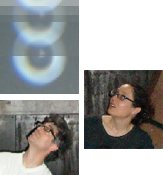
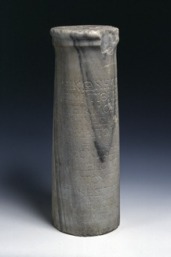
Catalyst Euterpe/Through the Waves is a project by artists Lili Maya and James Rouvelle (“maya+rouvelle”). Catalyst Euterpe was conceived as a series of events and objects based on the theme inscribed on the original Stele (shown below). This is our first installation of the project.
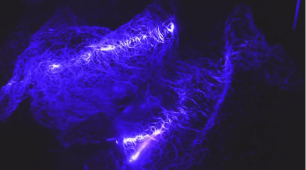
Catalyst Euterpe is a meditation on the paradox of the ephemeral and eternal – and how this paradox permeates life and culture, how it transforms, and how it is embodied in the Stele itself – its inscriptions and history. Our project traces this paradox across time and media – beginning with the original, hand carved, marble stele, through various incarnations into a presence both within networked, digital culture, and as sculptural objects and performance.
This edition, our first installment of this project (a second installment is scheduled for March 2019) will feature sculptural objects, a music composition, video and a live performance.
The sculptural objects will be exhibited in NYC (location still being confirmed) and in Trieste, Italy between November 17-27. In Italy the objects will be part of the Festival of Robotic Arts curated by Maria Campitelli – a founder of Trieste’s Gruppo78 and a leader in the curation of media art over the past half-century (!).
FROM the artists’ description of the project
 I’m looking forward to this conversation since I don’t have any recollection of ever having tackled anything like this before. It’s a challenge. It’s an expansion beyond my comfort zone. It’s an adventure….
So be listening tonight at 7pm at our website CosmosFM.org or on the radio at WNYE, 91.5 or use the TUNEIN app on your smart device.
Here are some links that you may find useful:
CLICK HERE FOR Maya & Rouvelle’s webpage.
CLICK HERE FOR Maya & Rouvelle’s Vimeo (video) page.
CLICK HERE FOR maya+rouvelle’s figure ground (video).
CLICK HERE FOR the Wikipedia entry for SEIKILOS EPITAPH.
CLICK HERE FOR the Wikipedia entry for the Antikythera mechanism.
CLICK HERE FOR The Senses: Design Beyond Vision at Cooper Hewitt museum CLOSES SUNDAY Oct. 28.
Tonight a conversation with Emily Wilson, translator of a beautiful new edition of Homer’s The Odyssey. Feb. 1, 2018
I really enjoyed my conversation with Emily Wilson from earlier this year so I thought it was time to air it again.
Bill


When I was eight years old, my primary school put on a production of a (much-shortened) Odyssey, complete with costumes, song, and dance. The play starred the cute troublemaker in my class as Odysseus, the headmaster of the school as Polyphemus (the one-eyed monster outwitted by his tiny opponents), and me in pigtails as the goddess Athena.
It was a turning point in my life.
from Emily Wilson’s Translator’s Note for The Odyssey
One of the first things I usually ask all my guests on Graffiti is what I call “The life-path” question: “How have you gotten to where you are today?” Or: “Was there something—an  event, maybe—that made you want to become a classicist?”
In many cases their first response is that there was no “turning point”, but when pressed (and I do press) there’s almost always “something”—as shown here in Emily’s case—that made them choose the path they…
View original post 158 more words
A Conversation with Steven Pressfield, author of The Artist’s Journey, August 30, 2018

When I looked over the list of Steve’s 17 published titles I was surprised to realize that this will be either the 6th or 7th time that we will be doing a program together. I was equally surprised to see that our last one—to talk about the publication of his book The Profession—was nearly 7 years ago.
 This evening we’ll be talking about his newest book entitled: The Artist’s Journey: The Wake of the Hero’s Journey and the Lifelong Pursuit of Meaning.
When you look at Steve’s list of published books you see that he’s split his time pretty evenly between fiction and non-fiction.
NON-FICTION
The War of Art (2002)
Do The Work (2011)
The Warrior Ethos (2011)
Turning Pro (2012)
The Authentic Swing: Notes from the Writing of First Novel (2013)
The Lion’s Gate: On the Front Lines of the Six Day War (2014)
An American Jew: A Writer Confronts His Own Exile and Identity (2015)
Nobody Wants to Read Your Sh*t: Why That Is and What You Can Do About It (2016)
FICTION
The Legend of Bagger Vance (1995)  Gates of Fire, about the Battle of Thermopylae (1998)
Tides of War, a Novel of Alcibiades and the Peloponnesian War (2000)
Last of the Amazons (2002) The Virtues of War, about Alexander the Great (2004).
The Afghan Campaign, about Alexander the Great’s conquests in Afghanistan (2006) Killing Rommel (2008)
The Profession (2011)
Tune in tonight at 7pm at our website CosmosFM.org or on the radio at WNYE, 91.5 or use the TUNEIN app on your smart device.
Click Here for the link to Steve’s website.
Click here for the link to his Wikipedia page.
Click here for the blog entry for Steve’s last appearance on Graffiti back in December of 2011.

 Just My Eyes